V-JEPA 2 Drake Simulation
Understand and use V-JEPA 2 using Drake simulation library for RL and ML tasks
V-JEPA 2 Integration with Drake Simulation
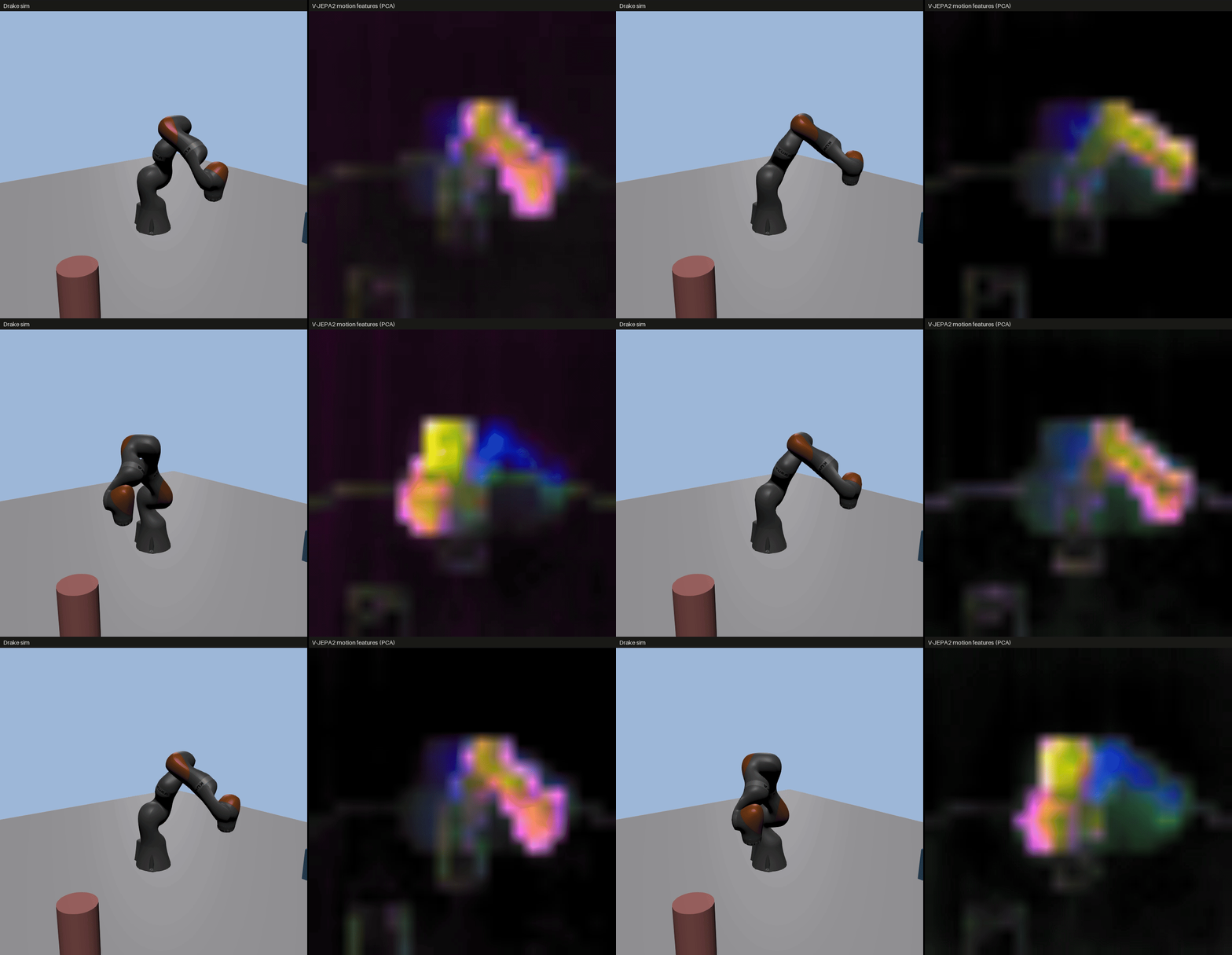
Overview
This project looks into finding if a pretrained JEPA video embeddings can capture meaningful differences in robot motion and provide a useful signal for control.
I use a Drake simulation with a KUKA iiwa arm to generate trajectories, extract V-JEPA2 embeddings from the rendered motion, and evaluate whether the latent space separates different movement behaviors.
I then use embedding similarity as a dense progress signal for a reaching task, with the goal of connecting learned video representations to practical robot control.
In Progress
V-JEPA 2 also introduced a Action-Conditioned world model V-JEPA 2-AC, the goal is to use the visual latent space from V-JEPA 2 and the action of the arm to predict the next latent space. My understanding of metas work flow:- Freeze the pretrained V-JEPA 2
- Train the model using arm trajectories
- Sample actions, predict the next timestep, compare to the goal embedding and run the best action
- Repeat in a MPC loop.
RL Reward
We can utilize the latent space from V-JEPA2 to create a reward function based only on the image. For this our reward function will take the cosine similarity between our embedding within a dt window (in this case 1 second) and a goal embedding, which comes from the last second of a single demonstration video.
Reward Function
We have 4 states to show this somewhat works: a nominal reach that finishes the task, one that stalls halfway through, one that undershoots the target, and one doing the wrong motion entirely. The reward ranks all 4 correctly without knowing anything about the task itself. So we get a signal that says "warmer" or "colder" at every timestep, from one demo video and zero reward engineering.
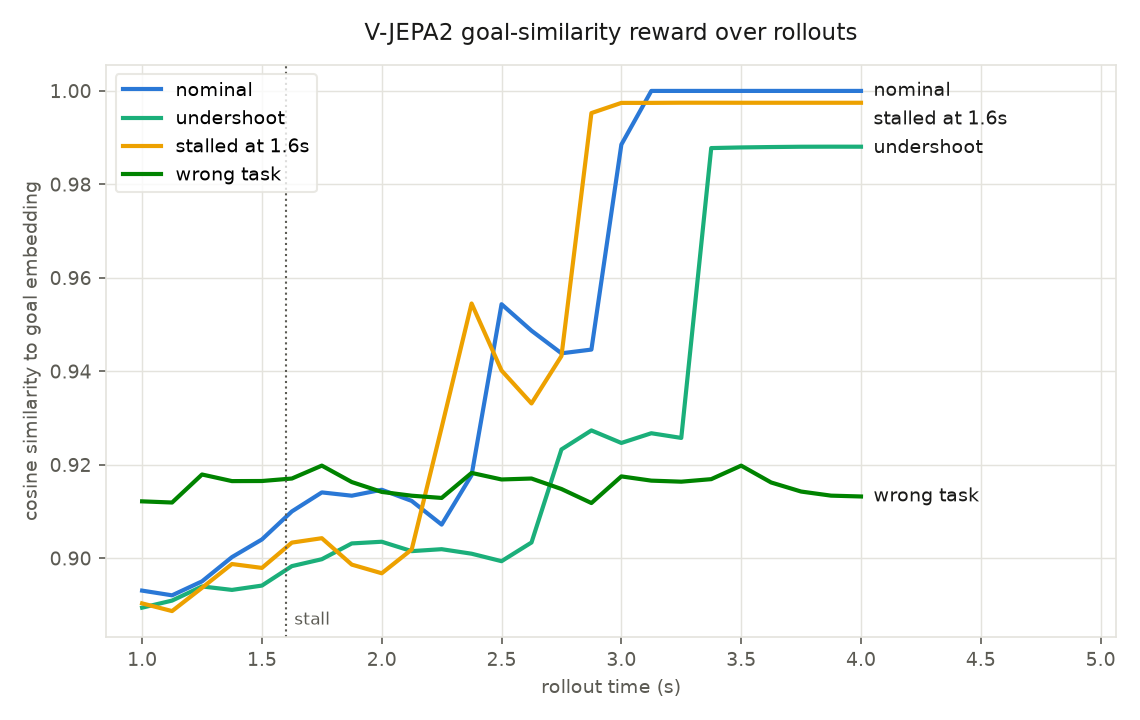
Two caveats. The raw cosine lives in a narrow band (~0.85 to 1.0) because the embedding space is anisotropic, so a real RL loop would likely likely normalize per task, e.g. pin the start frame at 0 and the goal at 1.
Second, the margins are small enough that compression matters decoding H.264 encoded frames shifts the embeddings, so everything here is scored on raw rendered frames, not decoded mp4s.
Still Ongoing Project
I'm still working on this to finetune V-JEPA 2-AC to work in both drakes simulation software and the KUKA iiwa, where as Meta used Frank Panda in thier model.